Information (All Originally from Canvas)
Please write an autobiography and literacy narrative, showing who you are, and what kind of experiences with language and writing you have had.
Consider how you can use media such as photos, other images, and music to deepen the reader's understanding of your text.
PART I Autobiography (about 700-800 words)
PART II: LITERACY NARRATIVE (about 700-800 words)
PART III: PHOTOS/IMAGES/LINKS
Here are some questions to help you think about this assignment.
Please use this as a guide: you don’t have to include answers to each question. Just write about whatever you would like to say about yourself and your experience.
What is your name? Where are you from?
What would you like me to know about you, so that I can help you during this class.
What do you enjoy doing in your free time?
What do you hope to get out of living and studying in the US?
What subjects interest you the most, and why?
When you are learning something new, what helps you most to keep motivated?
What languages (other than your own) have you studied, and what experiences have you had studying them?
What is your experience of academic writing? What do you find easy, and what do you find more difficult?
What is most challenging to you about explaining your own ideas to other people?
Do you enjoy thinking about other people’s ideas, and using your own words to discuss and write about them?
What is exciting for you about this process, and what is hard?
What kinds of non-academic writing do you do?
What is your relationship with words and language?
What kind of power do you think they have, and in what ways do you feel they are lacking?
What can your own language say that English cannot (and vice versa)?
After writing about yourself and your ideas about language and writing, incorporate into your narrative images and links showing ideas, activities, places,
and people that are important to you. For instance, if you are interested in a particular style of music, then include an audio or video link;
if you talk about a particular city, you could include an image which shows what is interesting to you about that city.
Make sure that these photos, images and links are as specific as possible, and make sure that they deepen the reader’s understanding of your text.
Autobiography


Part I: Autobiography
My name is Congrui Shen, but I like people to call me Alen. I was born in Shanghai, China. Shanghai is one of the biggest and most modern cities in the world. Growing up there meant I lived in a fast-changing place with strong school competition and many social rules. At the same time, my family and my personal hobbies shaped who I am. This story is not only about where I come from, but also about how I am trying to grow in new places.
When I was a child, I loved stories very much. My father gave me a set of Korean comic books about Greek mythology. This was one of the most special gifts in my life. Through those comics, I entered a world of gods, heroes, and complicated relationships. Even though I was very young, mythology opened my imagination and started my lifelong interest in storytelling. Since then, I have always liked creative work, such as drawing fan-art, writing my own stories, or simply daydreaming.
Art is one of my favorite ways to express myself. I like to draw characters from stories I admire, and sometimes I design my own original characters. When I create fan-art, I feel free to change the stories and imagine them in new ways. This makes me feel close to both language and visual culture. Besides art, I also enjoy ice-skating. When I skate, I feel balance and freedom, very different from the stress of school. These hobbies may look small, but they help me keep my own identity in a society where many people expect you to follow the same rules.
My academic interests also come from curiosity and imagination. The two subjects I like the most are neuroscience and mythology. Neuroscience is interesting to me because it connects biology and psychology, which were the most difficult subjects I studied in high school. For me, neuroscience explains how the brain and neurons control human behavior. Mythology, on the other hand, comes from my childhood love of stories. Neuroscience is about science and the human brain, while mythology is about culture and how people explain the unknown. Together, they show how I like to combine science and creativity.
When I lived in China, I often felt limited by my environment. Society had many restrictions, especially about diversity. There were strong stereotypes about gender, jobs, and personal choices. People were expected to follow the “social chain.” Individual differences were not welcomed, and this made me feel trapped. Moving to the United States for study means something very different. Here, I want to experience diversity, freedom, and more chances to express myself. Living in a multicultural environment is not only exciting but also important for me to grow as a student and as a person.
One of the hardest challenges for me is writing academic papers in English. Even though I studied in the IGCSE and IB programs, I still think writing is very difficult. I often cannot stay focused on my main idea, and sometimes I write too many extra details. I also have trouble choosing good references, especially when different essays give opposite ideas. Academic writing makes me feel stressed, but I also want to get better. I believe that with practice and support, I can learn to organize my ideas more clearly and write more effectively.
As a learner, I do best when I can talk with others. If I am studying something new, I feel more motivated when I can discuss with teachers or classmates. These conversations give me new energy and help me see things in different ways. At the same time, I value creativity and independence. I like writing fan-fiction in Chinese and sometimes think about translating my work into English. This shows not only my love for writing, but also my interest in connecting different cultures.
Looking to the future, I hope my time in the United States will help me grow both academically and personally. I want to improve my English writing, learn more about neuroscience and mythology, and practice my creative skills in art and storytelling. More importantly, I want to live in a place where diversity is respected and individuality is encouraged. My autobiography, like my life, is still in progress. But I know one thing: I will continue learning, creating, and exploring the world in my own way.
Part II: Literacy Narrative
Language has always been important in my life. My first language is Chinese, and I use it every day to talk with people and also for writing. I also studied English and Japanese. These languages gave me new chances to learn, but they were also difficult for me. My story about literacy is about how I struggled, how I grew, and how I continue to explore language as both a tool and an art.
My first experiences with language were in Chinese. I enjoyed reading and writing when I was young. I did not start with academic writing, but with fan-fiction. I liked to create stories about characters and worlds that I loved. Writing fan-fiction in Chinese gave me joy and freedom, because I could imagine things in my own way. I wrote not for school, but for myself. Through this, I learned that language is not only for communication, but also for self-expression and creativity.
Later, English became an important part of my education. I studied English seriously in the IGCSE and IB programs. In these classes, I had to write essays, read difficult texts, and explain my ideas in a second language. This was very hard for me. Academic writing in English gave me many problems. I often could not keep my thesis clear, and I added too many extra details. I also had trouble finding good sources. Sometimes I read different articles that said opposite things, and I felt very confused. There were times when I wanted to give up. Even so, these experiences showed me how much I need to practice, and they also pushed me to keep learning.
I also studied Japanese. For me, Japanese was not only about school, but also about culture. I was interested in comics and animation, and learning the language helped me enjoy them more. I am not fluent in Japanese, but learning it taught me an important lesson: every language has its own way of showing the world. For example, Japanese has many different ways to show politeness, and this is very different from Chinese or English. I realized that learning a language is not just about words or grammar—it is also about culture and perspective.
One of my biggest challenges with language is expressing my own ideas clearly, especially in English. Sometimes I cannot find the right words to explain what I mean. My thoughts are often more complicated than the words I know. But I also enjoy the process of learning from other people’s ideas and then adding my own. In group discussions, I often get inspired by classmates, and this helps me to share my own reflections. This process is exciting because I can learn from others, but it is also difficult because I need to explain my ideas more clearly.
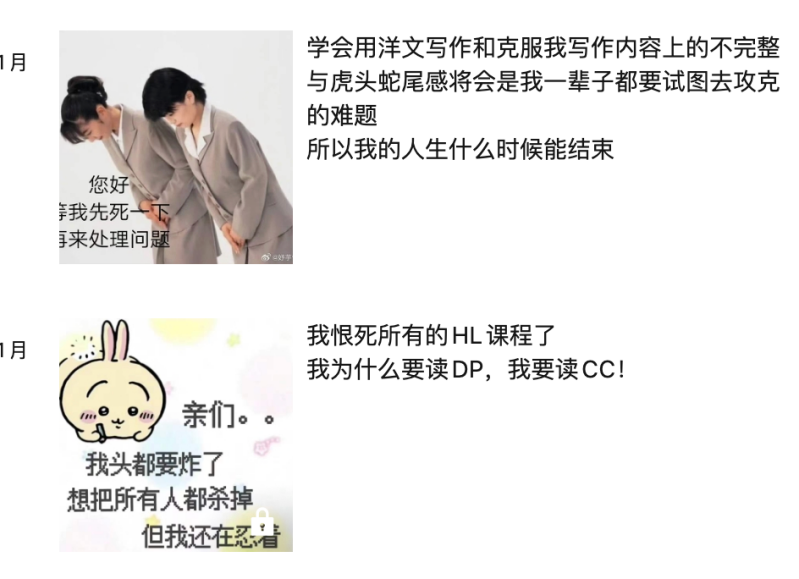
Me complaining about academic English Writing
Outside of school, my relationship with language is easier and more fun. Writing fan-fiction in Chinese lets me be free and creative. I also enjoy thinking about translation. Sometimes I try to translate my own stories into English, or I imagine how an English story would sound in Chinese. These exercises make me notice the differences between languages. For example, Chinese can say a lot with very few words, while English often has more exact words for abstract ideas. Both languages have strengths and weaknesses, but together they make my thinking richer.
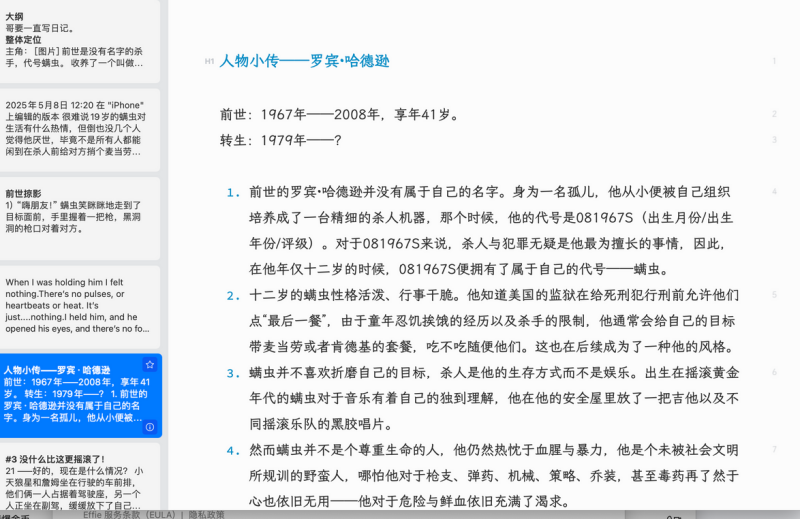
My works
I believe that words and language have strong power. They can change people’s minds, inspire emotions, and create new worlds. At the same time, I know that language is not perfect. Sometimes words cannot express everything I feel or think. But even with these limits, I see language as one of the most important tools for connection and imagination.
In conclusion, my literacy journey is full of both difficulties and discoveries. From writing fan-fiction in Chinese to writing essays in English, I have learned that language is not simple. It is powerful but also limited, enjoyable but also frustrating. As I continue my studies, I want to improve my English writing and keep my love for creative expression. Language will always be part of who I am—not only for studying, but also for living, thinking, and imagining.
Create Your Own Website With Webador